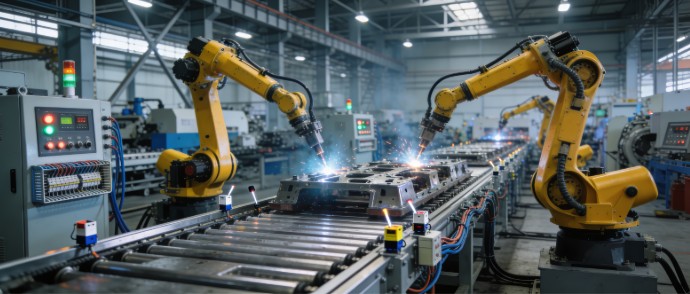
Walk into a modern factory and you won’t see many people turning wrenches on moving lines. You’ll see sensors blinking, robots moving in sync, and operators watching screens. That’s industrial automation in action.
For Ridgeback, this world is a core talent market. The more clearly we understand how automated plants work, the better we can match the right engineers and technicians to the right roles—for both traditional manufacturing clients and those building the next generation of AI‑driven “factories.”
This article walks through the basics of industrial automation, how it improves the manufacturing process, and what the key jobs Ridgeback recruits for actually do inside that system.
From manual work to automated production
At its core, manufacturing is simple:
-
Bring in raw materials.
-
Transform them through a series of steps.
-
Inspect the result.
-
Package and ship.
In a manual plant, people operate every major step—starting machines, moving materials, measuring parts, and recording results. In an automated plant, technology handles as much of that work as possible, so humans focus on setup, supervision, and problem‑solving.
Industrial automation uses three main building blocks:
-
Sensors – devices that measure things like position, speed, temperature, pressure, level, and weight.
-
Controllers – usually PLCs (programmable logic controllers) or DCS systems that read sensor data and decide what to do.
-
Actuators – motors, valves, cylinders, robots, and other equipment that actually move or change something.
Together, this loop runs thousands of times per second so the line can run safely and consistently without constant human input. Ridgeback focuses on the people who design, maintain, and optimize that loop.
The four layers of an automated factory
It helps to think of a factory as four logical layers stacked on top of one another. Each layer has specific talent needs—and Ridgeback recruits across all four.
1. Field level – sensors and actuators
This is the shop floor: motors turning conveyors, valves opening and closing, robots welding or picking parts. Sensors on these devices constantly send back information about what’s happening right now.
Typical equipment:
-
Proximity sensors that detect parts
-
Photoeyes on conveyors
-
Temperature and pressure transmitters on tanks and pipes
-
Servo motors, VFD‑driven motors, pneumatic cylinders, robots
Typical roles Ridgeback supports here
-
Automation Technicians
-
Maintenance Technicians
-
Electrical/Mechanical Technicians
These professionals install, inspect, and troubleshoot the physical hardware that keeps production moving. When a plant struggles with chronic downtime or can’t find enough skilled tradespeople, Ridgeback helps fill exactly these positions.
2. Control level – PLCs and drive systems
PLCs sit in control panels along the line and act like rugged industrial computers. They:
-
Read all the sensor inputs
-
Execute control logic (for example: “if bottle present, start filler,” “if pressure too high, open relief valve”)
-
Command drives, motors, and valves
If the field level is the body, the control level is the spinal cord that coordinates movement.
Typical roles Ridgeback supports here
-
Controls / Automation Engineers
-
PLC Programmers
-
Senior Automation Technicians
These people design and maintain the logic that makes machines behave properly. Ridgeback often helps clients upgrade this layer when they modernize lines, roll out new platforms, or standardize on a particular PLC vendor.
3. Supervisory level – HMIs and SCADA
Above the PLCs you have operator screens and supervisory software:
-
HMIs (Human‑Machine Interfaces) show what each machine or section of line is doing
-
SCADA (Supervisory Control and Data Acquisition) aggregates data from many PLCs and areas so engineers can monitor and control the whole plant
This is where alarms pop up, production data is logged, and recipes or setpoints get adjusted.
Typical roles Ridgeback supports here
-
SCADA / HMI Engineers
-
Controls Engineers with SCADA responsibility
-
Process Engineers and Supervisors (as power users)
When manufacturers want better visibility, fewer surprises, and actionable data, they invest in these roles. Ridgeback helps them find professionals who can turn raw signals into dashboards, alarms, and reports that operators actually use.
4. Planning level – MES, ERP, and analytics
At the very top, systems like MES (Manufacturing Execution System) and ERP tie the plant to the rest of the business:
-
Plan which orders to run and when
-
Track inventory and quality across shifts and sites
-
Analyze data to find bottlenecks and improvement opportunities
Typical roles Ridgeback supports here
-
Manufacturing / Process Engineers
-
Industrial Engineers
-
Data / Continuous Improvement Specialists
Ridgeback recruits in this layer because the decisions made here drive hiring needs everywhere else in the plant. When manufacturing and operations leaders have clear data on throughput, downtime, and quality, they know exactly where they need more technicians, controls engineers, and project talent—and that is where Ridgeback steps in to help them build the right teams.
How automation improves each step of manufacturing
Now let’s walk through the life of a product and highlight how automation changes each step.
1. Material handling and staging
Raw materials and components have to get from receiving to the right machine at the right time.
Automation adds:
-
Conveyor systems controlled by PLCs
-
Barcode or RFID scanning to confirm what’s moving
-
Automated storage and retrieval systems or AGVs that bring materials to the line
Impact on talent: plants need technicians and controls engineers who can keep these systems synchronized and reliable. Ridgeback often places automation techs and controls engineers into exactly this part of the process.
2. Production and assembly
This is where real value is created—mixing, cutting, forming, machining, welding, assembling, filling, or baking.
Automation adds:
-
Robotic welders, pick‑and‑place machines, and CNC equipment
-
Precisely programmed sequences: speeds, temperatures, timings
-
Automatic interlocks and safety checks so equipment can’t run in unsafe conditions
Impact on talent: line changes and new product introductions require controls engineers, project engineers, and integrators who understand both process and code. Ridgeback helps clients secure those people when they expand or overhaul production.
3. Inspection and quality control
Historically, inspectors sampled products by hand. Automated plants use:
-
Vision systems to check dimensions, labels, and surface defects
-
Sensors and test rigs to measure torque, pressure, flow, or weight
-
Automatic reject mechanisms that kick bad parts off the line
Impact on talent: quality‑driven plants look for engineers and technicians comfortable with vision systems, measurement hardware, and data analysis. Ridgeback identifies candidates who can bridge quality, automation, and IT.
4. Packaging, palletizing, and shipping
At the back end of the line, automation handles a lot of repetitive, ergonomic‑heavy work:
-
Case packers and cartoners
-
Labelers and print‑and‑apply systems
-
Palletizing robots and stretch‑wrappers
Impact on talent: the demand here is for field‑savvy technicians and controls engineers who can support complex packaging equipment and robotics. Ridgeback taps both OEM‑side and plant‑side talent pools to fill these needs.
5. Maintenance and reliability
Automation also supports maintenance:
-
Sensors and software track run time, vibration, temperature, and failures
-
Alerts flag when equipment is trending toward failure
-
PLCs and SCADA help technicians pinpoint where problems are occurring
Impact on talent: manufacturers are shifting from “run to failure” to preventive and predictive maintenance. Ridgeback recruits maintenance leaders and technicians who understand both traditional trades and modern diagnostics.
The key automation roles Ridgeback focuses on
Here are the main roles Ridgeback targets in industrial automation and how they fit into the picture above.
Automation Technician
Where they live in the stack:
Mostly at the field level, with some exposure to PLC panels.
Typical responsibilities:
-
Install and wire sensors, motors, valves, and control panels
-
Run conduit and cable; swap out failed components
-
Assist engineers with startups and small modifications
-
Troubleshoot day‑to‑day faults: a motor won’t start, a sensor isn’t seeing a part, a cylinder won’t move
These professionals are the front line that keeps machines running. Ridgeback often places Automation Technicians for manufacturers who are modernizing lines or struggling with downtime and can’t find enough skilled hands.
Controls / Automation Engineer
Where they live:
Primarily at the control and supervisory levels.
Typical responsibilities:
-
Design PLC logic and safety circuits for machines and lines
-
Configure HMIs and sometimes SCADA tags and screens
-
Define alarm limits, interlocks, and sequencing logic
-
Support startups, tuning, and upgrades when new equipment is installed
When a plant standardizes on a new PLC platform, adds a new line, or needs to improve uptime, these are the people they call. Ridgeback helps clients compete for scarce controls talent, and these same engineers can often transition into power, data‑center, or building‑automation work.
SCADA / HMI Engineer
Where they live:
At the supervisory level.
Typical responsibilities:
-
Build operator screens, trends, and alarm dashboards
-
Integrate multiple PLCs and data sources into a single view
-
Configure logging so production and quality data are stored for analysis
-
Work with operators and maintenance to make interfaces intuitive and useful
Ridgeback works with manufacturers who want to move beyond clipboards and spreadsheets and need SCADA/HMI talent to unlock the value of their data.
Field Service Engineer (Automation / OEM)
Where they live:
Mostly on the road, at customer sites.
Typical responsibilities:
-
Install and commission OEM machines and automation systems
-
Load PLC/HMI programs, tune drives, test I/O and safety systems
-
Diagnose complex problems that local teams couldn’t solve
-
Train customer maintenance and production staff
OEMs, system integrators, and service companies rely on these engineers to keep their installed base running. Ridgeback focuses on Field Service roles because they are in chronic short supply and map directly into critical‑infrastructure and data‑center service jobs.
System Integrator / Project Engineer (Automation)
Where they live:
Across all levels, especially during design and implementation.
Typical responsibilities:
-
Design full automation solutions: hardware architecture, control networks, panel layouts
-
Coordinate mechanical, electrical, and software work with vendors and internal teams
-
Manage timelines, testing (FAT/SAT), documentation, and handover to operations
Ridgeback partners with integrators and project‑driven manufacturers who need these engineers to deliver new lines and upgrades on time.
Bringing it all together
Industrial automation is not just “robots replacing people.” It is a layered control system that runs through the entire manufacturing process:
-
Sensors and actuators at the field level
-
PLCs coordinating machines at the control level
-
HMIs and SCADA giving people visibility at the supervisory level
-
MES and ERP tying production to the business at the planning level
Ridgeback recruits across this stack—from hands‑on technicians to controls, SCADA, and project engineers—so manufacturers and infrastructure providers can keep their automated operations running reliably and scale into new areas like AI data centers and critical power.